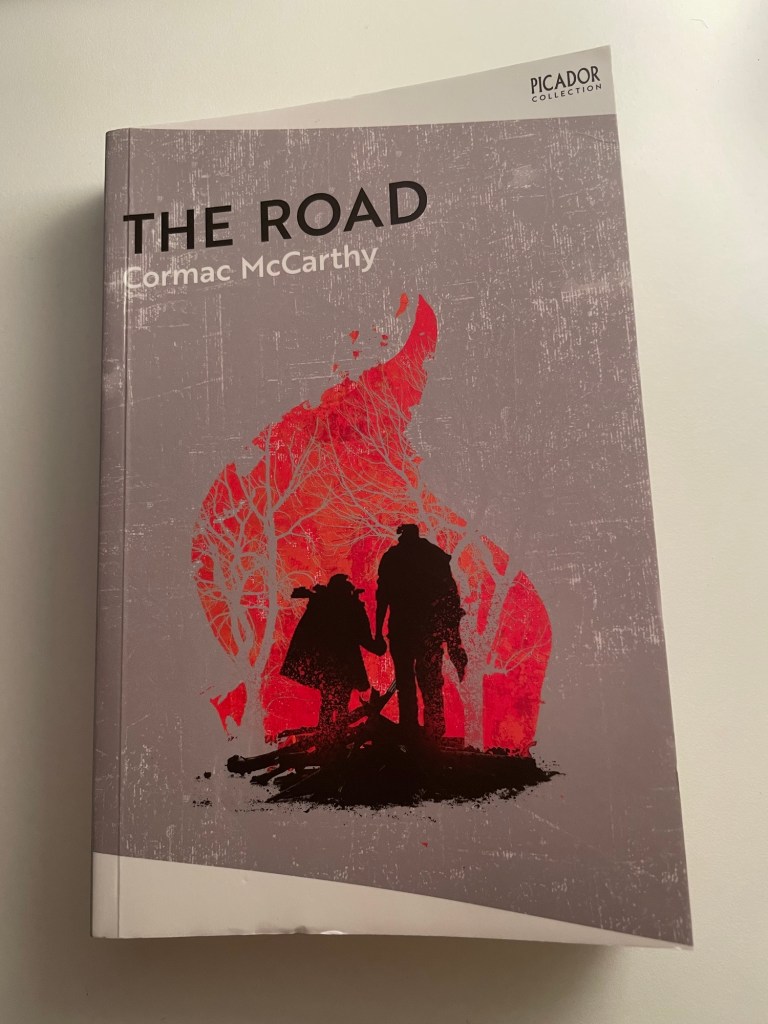
The Road was the first novel I read cover-to-cover in one sitting. I bought it in 2009, before the film came out, while I was still at university. I was living in a small box room in Kennington and it was the winter. I started the first page in the late morning and read straight through until the evening. I couldn’t put it down. It also gave me bad dreams for a week.
That happened again when I re-read it. Thanks, Cormac.
It is worth saying up front that I am a huge McCarthy fan and a sucker for end-of-the-world films and books. So this book was always going to be firmly in my wheelhouse. It was the first McCarthy book I read. The second was No Country for Old Men but I didn’t pick that up for almost ten years. I then went on a tear through the Border Trilogy and Blood Meridian. I’ve since read Stella Maris but not The Passenger.
I tried reading Suttree but I couldn’t get into it. I’ve heard City of God is good but in reality I’m ok with re-reading the ones I’ve already read. They are that good.
The Road is a fairly straightforward narrative. Following an unnamed mass extinction event that renders the American landscape ashen and cold, two nameless characters, a man and his son, struggle to survive daily life while constantly on the move.
Their ultimate destination is the East Coast, where the man hopes to find warmer weather and safety for his son.
McCarthy is at his best when his characters are on the move and relying on their resourcefulness to survive. Think of Llewelyn Moss treating his gunshot wounds in No Country for Old Men. Billy pursuing the wolf in The Crossing. And the unnamed protagonist of The Road suturing an arrow wound with a homemade first aid kit. Resourcefulness is a theme. But McCarthy’s lyrical descriptions of bleak landscapes are also best when his characters are moving through them.

Bleakness and a sense of nihilism runs throughout The Road. There is no redemption, there is no god. We die and the world doesn’t care.
But the twist at the end of The Road is that there is hope. In No Country and Blood Meridian, there are similar themes of good vs evil and whether there is a god or not.
“I always figured when I got older God would sort of come into my life somehow. And He didn’t. And I don’t blame him.”
Ed Tom, No Country for Old Men
And in The Road:
There is no God and we are his prophets.”
The Road
But whereas evil triumphs in Blood Meridian and No Country, the ending of The Road (with the son burying his dad and joining a group of other survivors who might be good) is left ambiguous – we are left to believe that in this instance good has a chance of triumphing over evil.
The other ambiguity in the novel is whether the man and his son are good or evil.
The man consistently reassures his son that they are the good guys. They hold the fire. Whereas others do not.
This is shown most clearly in the scenes where others have turned to cannibalism to survive.
But are the man and his son good? A couple of scenes suggest it is not clear cut.
The man and his son consistently come across houses that seem abandoned and ransacked yet have food and supplies they can take.
Later, when they are camping on the beach another person ransacks their camp and steals their food. The man catches him, forces him to strip naked and return their food.
They leave him to die. Similarly, towards the end of the novel, the man shoots the archer who injures him in the port town. Is this the behaviour of someone who is good? Are the man and his son stealing food and supplies from unseen others in the same way that the man steals from them on the beach?
We don’t know the answer, but it is not clear cut that the man and his son are good. It is left ambiguous.
 Track Changes
Leave a comment